![[CH08]DQN](https://d-sketon.top/img/_backwebp/bg11.webp)
零、写在前面
其实直接把 Q 学习 和 神经网络结合是不太好的,二者一个依赖强相关数据,一个依赖随机数据,那么我们可以通过一些策略来解决这个问题。
一、OpenAI Gym
OpenAI Gym 是一个开源库,提供了各种强化学习任务(环境),如:
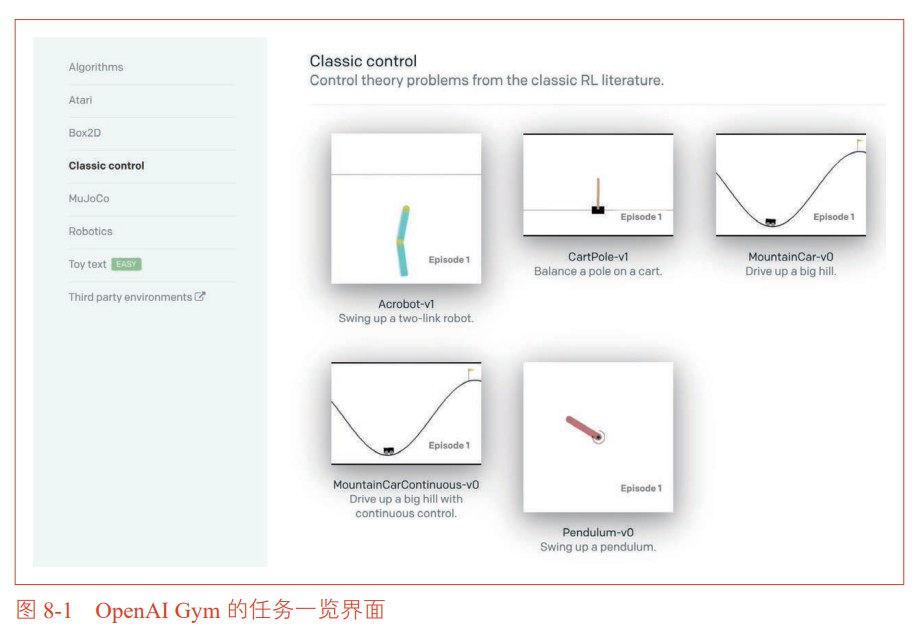
1.1 OpenAI Gym 的基础知识
先安装:
pip install gymnasium
以游戏 CartPole 为例:
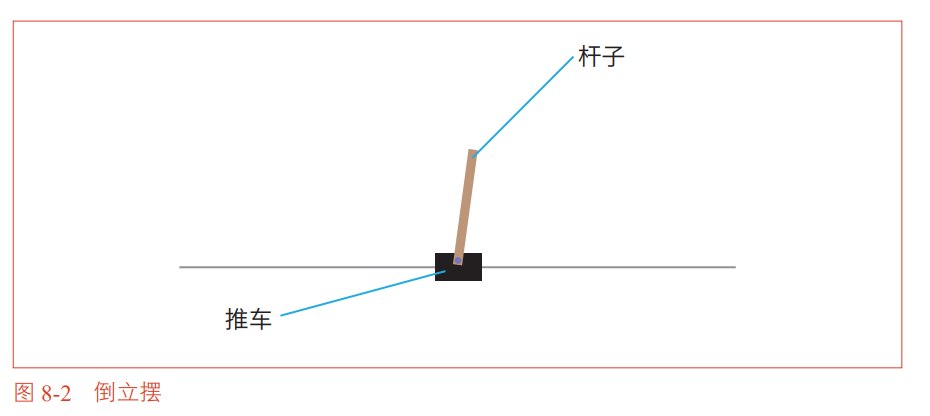
CartPole 的状态是四维向量:
| 位置 | 物理量 |
|---|---|
| 0 | 小车位置 |
| 1 | 小车速度 |
| 2 | 杆的角度 |
| 3 | 杆的角速度 |
动作空间为 Discrete(2):0 向左施力,1 向右施力。杆保持直立时每步通常得到奖励 1,一个 episode 到达失败条件或时间上限后结束。
写个脚本演示下:
import numpy as np
import gymnasium as gym
import time

env = gym.make('CartPole-v1', render_mode='human')

state, info = env.reset()
done = False

while not done:
    # 渲染画面
    env.render()

    # 随机选择一个动作
    action = env.action_space.sample()

    # 与环境交互
    next_state, reward, terminated, truncated, info = env.step(action)

    done = terminated or truncated
    state = next_state

    # 稍微暂停一下,否则画面运行太快,一闪而过
    time.sleep(0.05)

env.close()
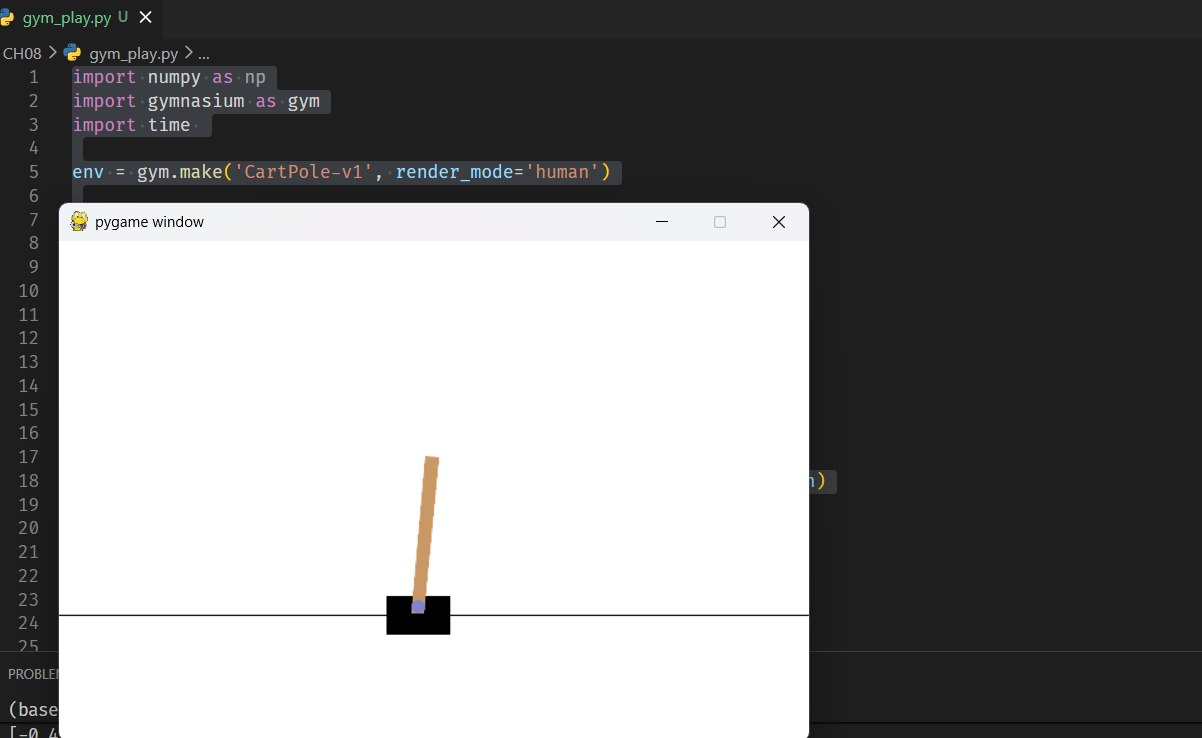
基本 1s 就似了:
二、DQN 原理
2.1 经验回放:把在线轨迹变成随机 minibatch
使用神经网络成功解决监督学习问题的案例有很多。但在 2013 年 DQN 发表之前,几乎没有使用神经网络成功解决强化学习问题的案例。
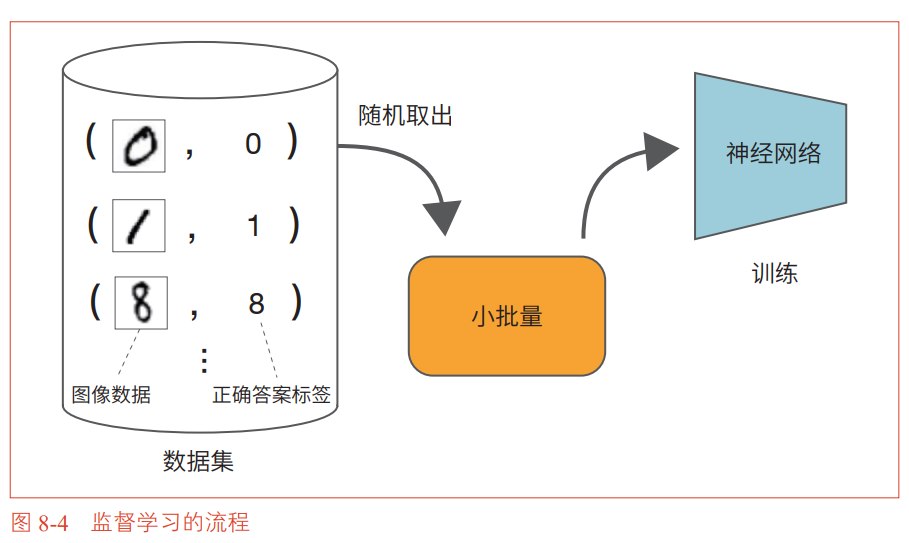
神经网络解决监督学习问题通常采用随机批量梯度下降,而 Q 学习进行状态转移的数据却存在强相关性,这就导致如果直接用神经网络来做 Q 学习就很容易出现过拟合。
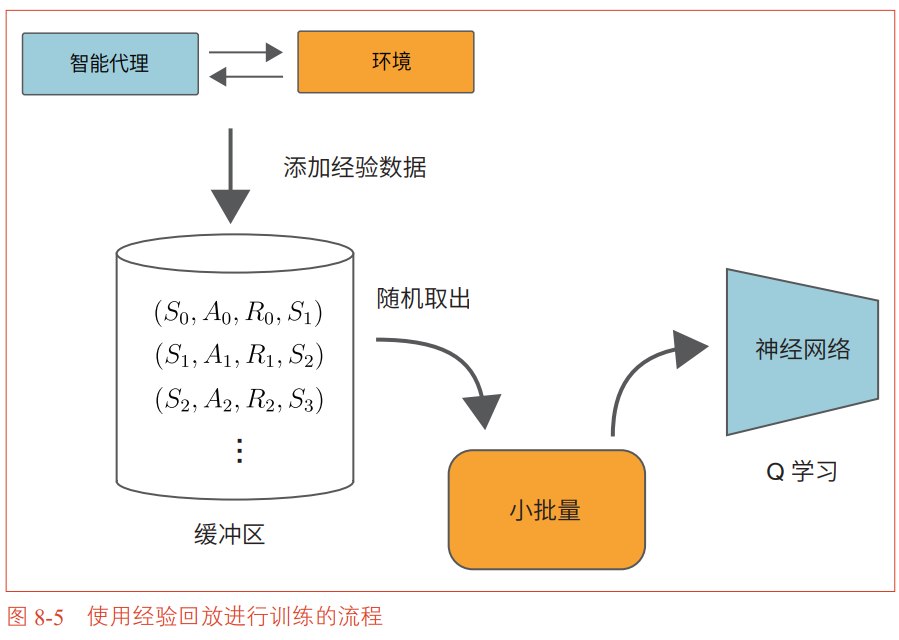
经验回放的流程很简单,一次经验可以写成
$$ E_t=(S_t,A_t,R_t,S_{t+1}). $$然后把经验保存到“缓冲区”中。在更新 Q 函数时,从缓冲区中随机取出经验数据并使用。
程序还需知道是否终止,因此 buffer 实际保存
$$ (s,a,r,s',d). $$其中 $d=1$ 表示没有后续价值可 bootstrap。Replay buffer 是有限 FIFO 队列:
self.buffer = deque(maxlen=buffer_size)
容量满时最早经验自动丢弃。每次更新不取最新一条经验,而是随机抽取 $B$ 条:
data = random.sample(self.buffer, self.batch_size)
它带来三件事:
- 减弱相邻样本相关性:随机混合后,一个 batch 内的样本通常不再是一段连续轨迹;
- 重复利用经验:一条环境交互数据可在后续多次被抽到,提高数据效率;
- 稳定梯度估计:用 minibatch 平均,而不是让一条新样本完全决定参数更新。
这不意味着数据变成严格 IID,也不意味着探索已经充分。buffer 中的数据仍来自过去的行为策略,分布会随训练改变。
值得注意的是,经验回放只适用于 off-policy。
Q-learning 的 target 是 $\max_aQ(s',a)$,它学习贪婪目标策略的价值;产生数据的行为策略可以是 epsilon-greedy,因此旧数据仍可用于更新。SARSA 的 target 含当前行为策略实际选择的下一动作,不能不加处理地把旧策略数据拿来回放。
2.2 经验回放的实现
from collections import deque
import random
import numpy as np
import gymnasium as gym
import time

class ReplayBuffer:
    def __init__(self, buffer_size, batch_size):
        self.buffer = deque(maxlen=buffer_size)
        self.batch_size = batch_size

    def add(self, state, action, reward, next_state, done):
        data = (state, action, reward, next_state, done)
        self.buffer.append(data)

    def __len__(self):
        return len(self.buffer)

    def get_batch(self):
        data = random.sample(self.buffer, self.batch_size)

        state = np.stack([x[0] for x in data])
        action = np.array([x[1] for x in data])
        reward = np.array([x[2] for x in data])
        next_state = np.stack([x[3] for x in data])
        done = np.array([x[4] for x in data]).astype(np.int32)
        return state, action, reward, next_state, done
写个脚本测一下:
env = gym.make('CartPole-v1', render_mode='human')
replay_buffer = ReplayBuffer(buffer_size=10000, batch_size=32)

for episode in range(10):
    state, info = env.reset()
    done = False

    while not done:
        env.render()

        action = 0
        next_state, reward, terminated, truncated, info = env.step(action)
        replay_buffer.add(state, action, reward, next_state, done)
        state = next_state
        done = terminated or truncated

        time.sleep(0.05)

env.close()

state_batch, action_batch, reward_batch, next_state_batch, done_batch = replay_buffer.get_batch()
print(state_batch.shape)      # (32, 4)
print(action_batch.shape)     # (32,)
print(reward_batch.shape)     # (32,)
print(next_state_batch.shape) # (32, 4)
print(done_batch.shape)       # (32,)
2.3 目标网络:固定一段时间的监督标签
只有 replay 还不够。若 target 仍由正在更新的 $Q_\theta$ 计算,每一步参数更新都会改变监督标签。DQN 维护两张相同结构、职责不同的网络:
| 网络 | 用途 | 会被反向传播更新吗? |
|---|---|---|
| qnet,$Q_\theta$ | 选 epsilon-greedy 行动;预测当前 $Q_\theta(s,a)$ | 会 |
| qnet_target,$Q_{\bar\theta}$ | 计算下一状态最大 Q 值,构造 TD target | 不会 |
标准 DQN target 为:
$$ y_i=r_i+(1-d_i)\gamma\max_aQ_{\bar\theta}(s'_i,a). \tag{8.1} $$目标网络不会每一步跟随 online network。经过 $C$ 个间隔后硬复制:
$$ \bar\theta\leftarrow\theta. $$2.4 目标网络的实现
import random
from typing import Any

import numpy as np
import torch
from torch import Tensor, nn
from torch.nn import functional as F
from torch.optim import Adam

import matplotlib.pyplot as plt
import gymnasium as gym

from replay_buffer import ReplayBuffer

STATE_SIZE = 4
ACTION_SIZE = 2


class QNet(nn.Module):
    def __init__(self, state_size: int = STATE_SIZE, action_size: int = ACTION_SIZE) -> None:
        super().__init__()
        self.l1 = nn.Linear(state_size, 128)
        self.l2 = nn.Linear(128, 128)
        self.l3 = nn.Linear(128, action_size)

    def forward(self, states: Tensor) -> Tensor:
        hidden = F.relu(self.l1(states))
        hidden = F.relu(self.l2(hidden))
        return self.l3(hidden)


class DQNAgent:
    def __init__(
        self,
        state_size: int = STATE_SIZE,
        action_size: int = ACTION_SIZE,
        *,
        gamma: float = 0.98,
        lr: float = 0.0005,
        epsilon: float = 0.1,
        buffer_size: int = 10_000,
        batch_size: int = 32,
        device: torch.device | str = "cpu",
    ) -> None:
        self.gamma = gamma
        self.lr = lr
        self.epsilon = epsilon
        self.action_size = action_size
        self.batch_size = batch_size
        self.device = torch.device(device)

        self.replay_buffer = ReplayBuffer(buffer_size, batch_size)
        self.qnet = QNet(state_size, action_size).to(self.device)
        self.qnet_target = QNet(state_size, action_size).to(self.device)
        self.qnet_target.eval()
        for parameter in self.qnet_target.parameters():
            parameter.requires_grad_(False)
        self.optimizer = Adam(self.qnet.parameters(), lr=self.lr)

    def get_action(self, state: np.ndarray) -> int:
        if np.random.rand() < self.epsilon:
            return int(np.random.choice(self.action_size))

        state_tensor = torch.as_tensor(state, dtype=torch.float32, device=self.device)
        if state_tensor.ndim == 1:
            state_tensor = state_tensor.unsqueeze(0)
        with torch.no_grad():
            qs = self.qnet(state_tensor)
        return int(qs.argmax(dim=1).item())

    def compute_target(self, rewards: Tensor, next_states: Tensor, dones: Tensor) -> Tensor:
        """补充:计算目标 Q 值"""
        with torch.no_grad():
            next_qs = self.qnet_target(next_states)
            max_next_qs = next_qs.max(dim=1).values
            target = rewards + (1.0 - dones.float()) * self.gamma * max_next_qs
        return target

    def update(
        self,
        state: np.ndarray,
        action: int,
        reward: float,
        next_state: np.ndarray,
        done: bool,
    ) -> float | None:
        self.replay_buffer.add(state, action, reward, next_state, done)
        if len(self.replay_buffer) < self.batch_size:
            return None

        states, actions, rewards, next_states, dones = self.replay_buffer.get_batch()

        states = torch.as_tensor(states, dtype=torch.float32, device=self.device)
        actions = torch.as_tensor(actions, dtype=torch.long, device=self.device)
        rewards = torch.as_tensor(rewards, dtype=torch.float32, device=self.device)
        next_states = torch.as_tensor(next_states, dtype=torch.float32, device=self.device)
        dones = torch.as_tensor(dones, dtype=torch.float32, device=self.device)

        all_qs = self.qnet(states)
        current_q = all_qs.gather(dim=1, index=actions.unsqueeze(1)).squeeze(1)
        target = self.compute_target(rewards, next_states, dones)
        loss = F.mse_loss(current_q, target)

        self.optimizer.zero_grad()
        loss.backward()
        self.optimizer.step()
        return float(loss.item())

    def sync_qnet(self) -> None:
        self.qnet_target.load_state_dict(self.qnet.state_dict())
        self.qnet_target.eval()
写个脚本跑300次:
episodes = 300
sync_interval = 20

env = gym.make('CartPole-v1')
# env = gym.make('CartPole-v1', render_mode='human')
agent = DQNAgent(device= 'cuda' if torch.cuda.is_available() else 'cpu')

reward_history = [0] * episodes
for episode in range(episodes):
    state, _ = env.reset()
    done = False
    total_reward = 0

    while not done:
        action = agent.get_action(state)
        next_state, reward, terminated, truncated, info = env.step(action)

        done = terminated or truncated
        agent.update(state, action, reward, next_state, done)

        state = next_state
        total_reward += reward

    if episode % sync_interval == 0:
        agent.sync_qnet()
	reward_history.append(total_reward)

env.close()

figure, axis = plt.subplots()
axis.set_xlabel("Episode")
axis.set_ylabel("Total Reward")
axis.plot(range(len(reward_history)), reward_history)
figure.tight_layout()
plt.show()
曲线很夸张:
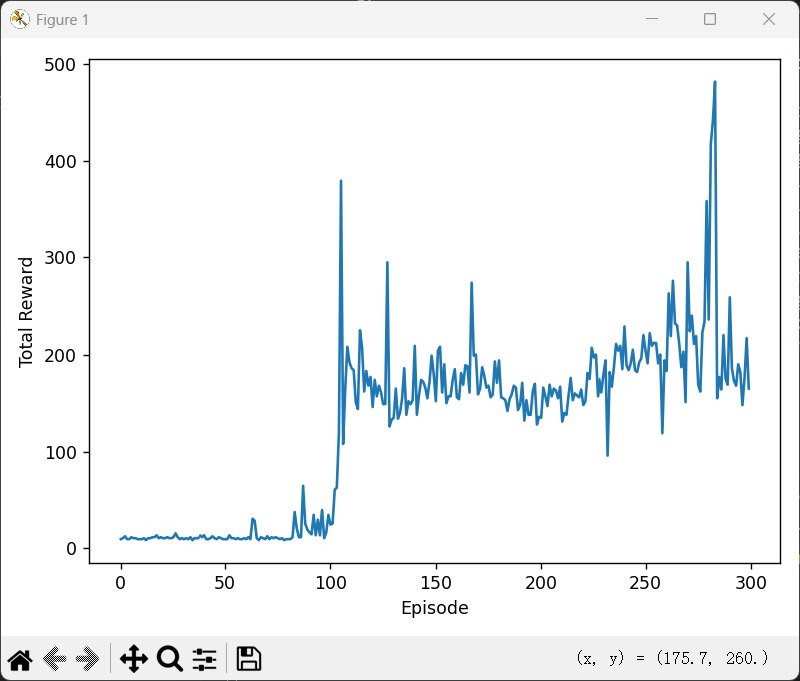
因为强化学习的训练曲线变动是很大的,我们不能仅凭一次结果评判,所以进行100次实验取平均:
iters = 100
episodes = 300
sync_interval = 20

env = gym.make('CartPole-v1')
# env = gym.make('CartPole-v1', render_mode='human')
agent = DQNAgent(device= 'cuda' if torch.cuda.is_available() else 'cpu')

avg_history = [0] * episodes
for i in range(iters):
    for episode in range(episodes):
        state, _ = env.reset()
        done = False
        total_reward = 0

        while not done:
            action = agent.get_action(state)
            next_state, reward, terminated, truncated, info = env.step(action)

            done = terminated or truncated
            agent.update(state, action, reward, next_state, done)

            state = next_state
            total_reward += reward

        if episode % sync_interval == 0:
            agent.sync_qnet()

        avg_history[episode] += total_reward

for i, x in enumerate(avg_history):
    avg_history[i] = x / 100

env.close()

figure, axis = plt.subplots()
axis.set_xlabel("Episode")
axis.set_ylabel("Total Reward")
axis.plot(range(len(avg_history)), avg_history)
figure.tight_layout()
plt.show()
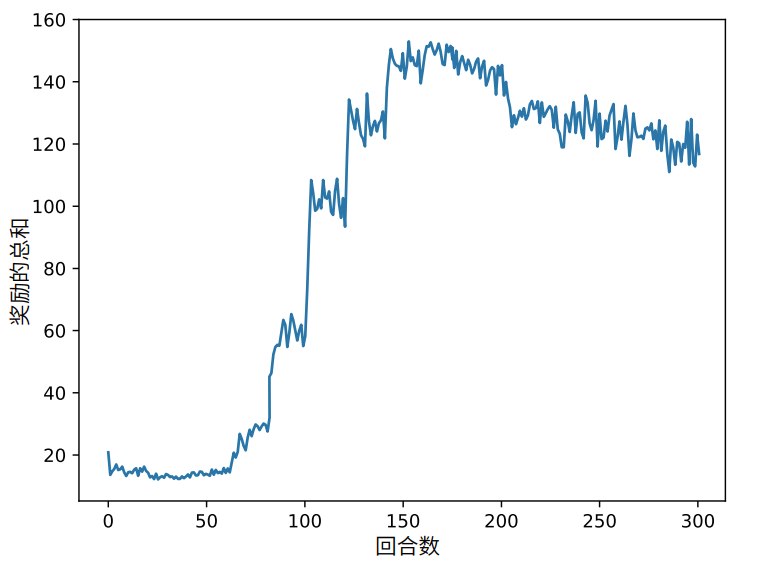
然后我们让训练后的 Agent 基于 ε-greedy 来采取行动:
agent.epsilon = 0 # 贪婪策略
state = env.reset()
done = False
total_reward = 0

while not done:
    action = agent.get_action(state)
    next_state, reward, done, info = env.step(action)
    state = next_state
    total_reward += reward
    env.render()
print('Total Reward:', total_reward)
Total Reward: 116
三、DQN 和 Atari
CartPole 是小型教学环境。DQN 出名的重要背景是 Atari。
Atari 是一家游戏开发商,其业务涉及街机游戏、游戏机和个人电脑行业。在强化学习领域,Atari 制作的怀旧游戏软件被称为“Atari”。
由于 Atari 的游戏比前面的 CartPole 复杂的多,训练往往需要一天,所以这里就不针对相关代码展开了。
3.1 Atari 的游戏环境
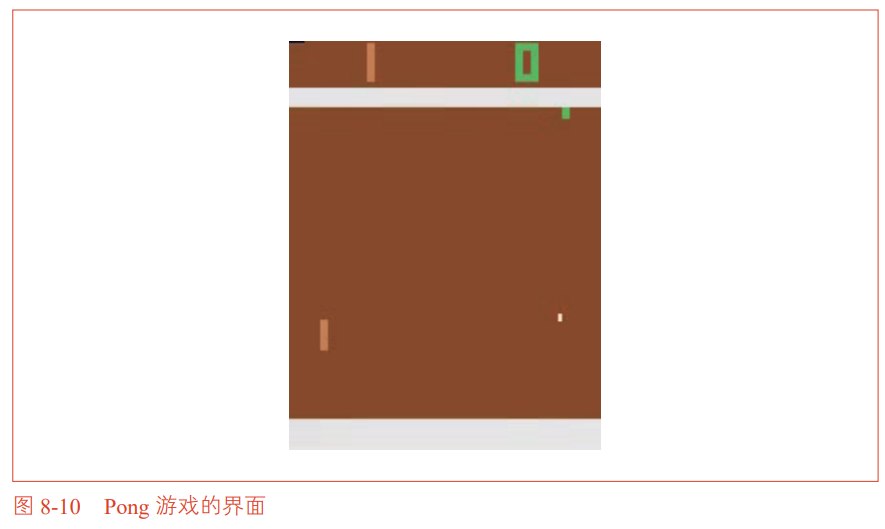
这个游戏还是蛮经典的,高中的时候同桌经常用 apple watch 玩。
Pong 说明:原始屏幕为 $210\times160\times3$ RGB 图像,单帧通常无法看出球的运动方向。
若图像只显示球当前位置、不显示速度方向,仅凭该帧无法完全决定未来转移分布。对代理而言,这更接近部分可观测 MDP(POMDP)。
我们把连续四帧堆叠为状态:
$$ s_t=(x_{t-3},x_{t-2},x_{t-1},x_t). $$由于帧间位置变化携带粗略的运动信息,使输入更接近 Markov 状态。
3.2 预处理
DQN 的论文中还在重叠帧之前进行了一些例行处理。具体包括
$$ 210\times160\times3 \rightarrow \text{裁剪} \rightarrow \text{灰度化} \rightarrow \text{缩放} \rightarrow \text{归一化到 }[0,1] \rightarrow 4\text{ 帧堆叠}. $$3.3 CNN
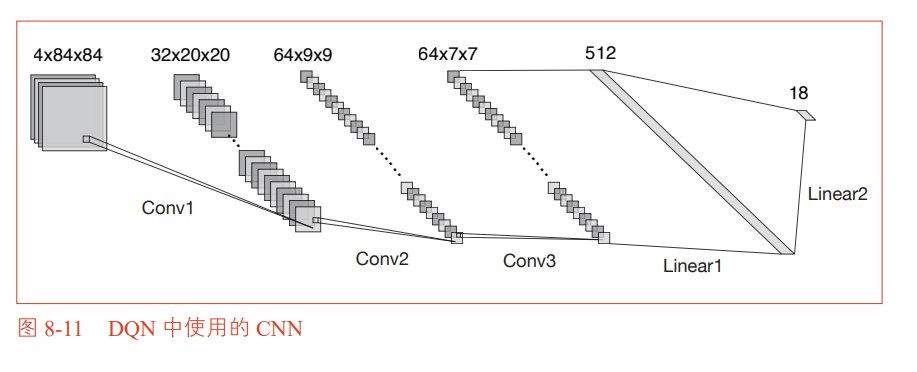
随后使用:
$$ 4\times84\times84 \rightarrow \text{Conv}(32) \rightarrow \text{Conv}(64) \rightarrow \text{Conv}(64) \rightarrow \text{Linear}(512) \rightarrow \text{Linear}(|\mathcal A|) $$的 CNN。
3.4 其他技巧
我们可以通过GPU/TPU加速训练;
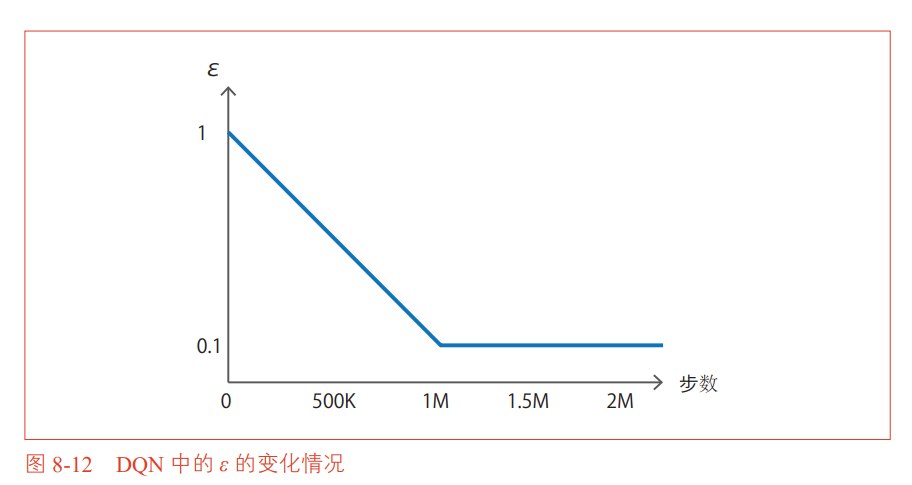
将 epsilon 在前 100 万步从 1.0 线性降到 0.1
奖励裁剪到 $[-1,1]$。
四、DQN 的扩展
4.1 Double DQN:缓解最大化过估计
标准 DQN 使用
$$ r+(1-d)\gamma\max_aQ_{\bar\theta}(s',a). $$Double DQN 将“选动作”和“评估动作”拆给两张网络:
$$ r+(1-d)\gamma Q_{\bar\theta} \left(s',\arg\max_aQ_\theta(s',a)\right). \tag{8.2} $$online network 用 argmax 选动作编号,target network 只评估那个动作的数值,从而缓解 max 对噪声偏大的倾向。
普通 DQN max算子放大了 估计值 Q 所携带的误差,通过选出 Q 值最大的行动,可以使得训练更稳定。
4.2 优先级经验回放
均匀回放对每条经验一视同仁。优先级经验回放依据 TD error:
$$ \delta_i=\left| r_i+(1-d_i)\gamma\max_aQ_{\bar\theta}(s'_i,a) -Q_\theta(s_i,a_i)\right|, \qquad p_i=\frac{\delta_i}{\sum_k\delta_k}. \tag{8.3} $$直觉是:目前预测得很不准的样本更值得复习。
$$ \tilde p_i=(|\delta_i|+\varepsilon_p)^\alpha,\qquad p_i=\frac{\tilde p_i}{\sum_k\tilde p_k}, $$4.3 Dueling DQN
引入 advantage function:
$$ A^\pi(s,a)=Q^\pi(s,a)-V^\pi(s),\qquad Q^\pi(s,a)=V^\pi(s)+A^\pi(s,a). \tag{8.4} $$Dueling 网络先共享特征提取,再分为 value 分支与 advantage 分支。它适合很多动作好坏相近的状态:先判断“状态整体好不好”可能比独立估计每个动作更有效。

说些什么吧!