
零、写在前面
依旧不知道干啥,随便跑点代码。
基本就是 ai 写一些数据处理的API,然后过一下流程。
一、Building a math verifier
LLM 评估,常见的就是:
- multiple choice
- verifier
- leaderboards
- LLM as Judge
从更大的视角看,这四种方法可以分成两拨:
| 大类 | 包含的方法 | 特点 |
|---|---|---|
| 基于基准的评估(benchmark-based) | multiple choice、verifier | 偏定量,可自动复现 |
| 基于判断的评估(judgment-based) | leaderboards、LLM as Judge | 更依赖定性判断 |
对推理模型来说,比较适合verifier。
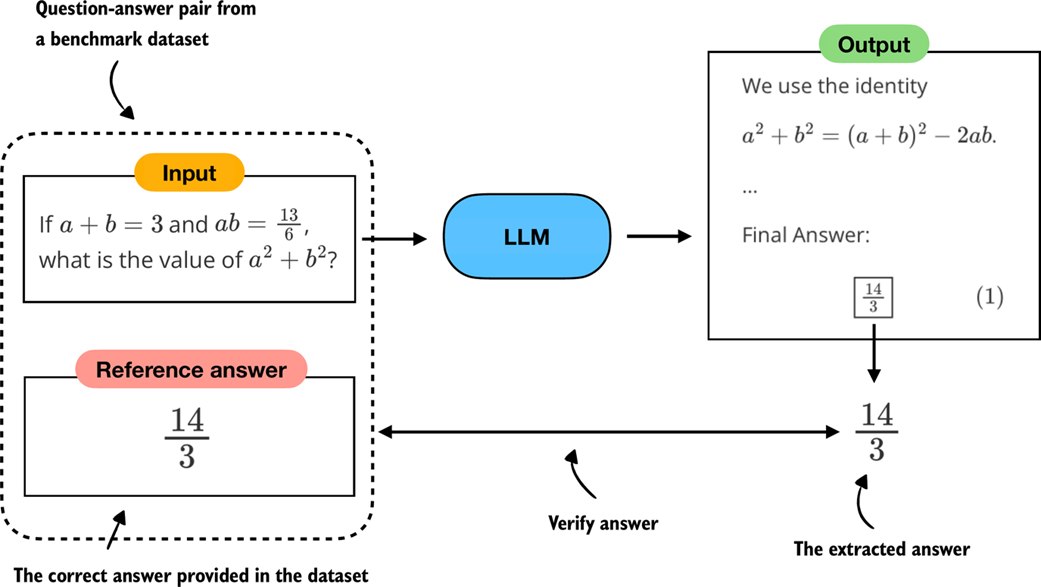
比如一些 math problem 的 bench,虽然解题可能需要长程推理,但是最后的测评只需要一个具体的答案。
流程:
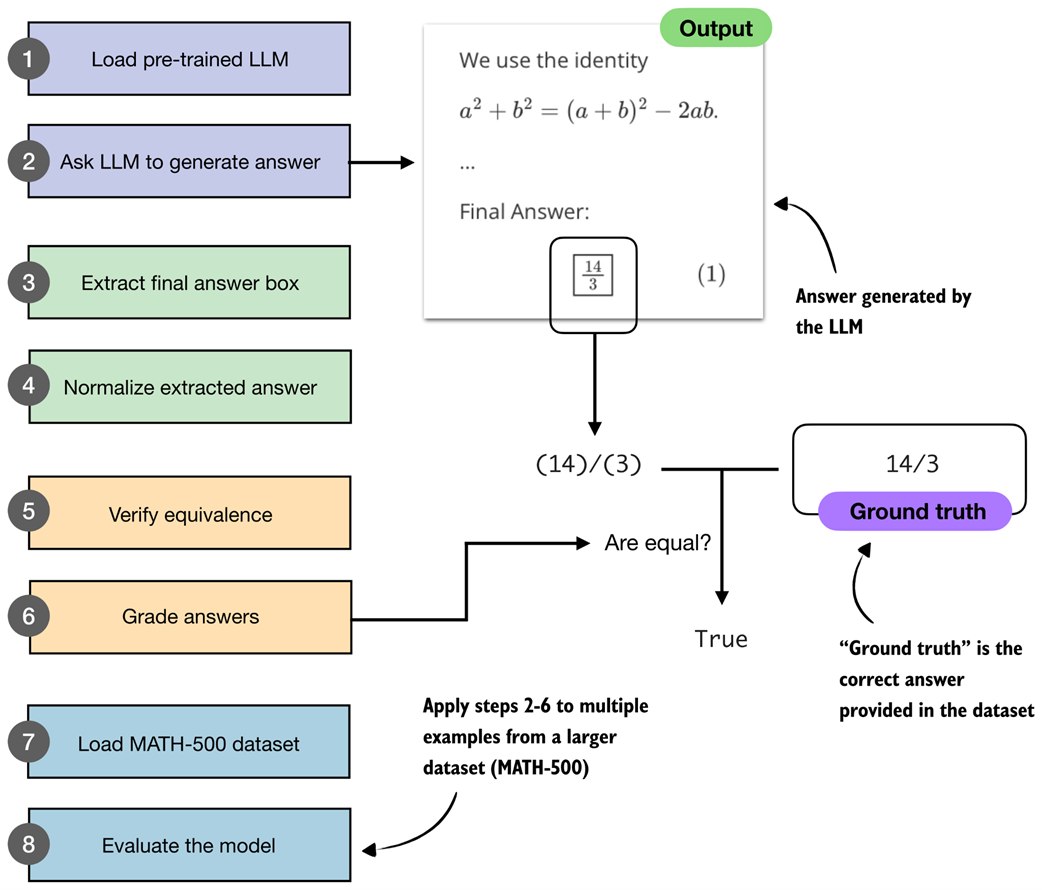
二、Loading a pre-trained model to generate text
2.1 加载预训练模型
from pathlib import Path
import torch

from reasoning_from_scratch.ch02 import (
    get_device
)
from reasoning_from_scratch.qwen3 import (
    download_qwen3_small,
    Qwen3Tokenizer,
    Qwen3Model,
    QWEN_CONFIG_06_B
)

def load_model_and_tokenizer(
    which_model, device, use_compile, local_dir="qwen3"
):
    if which_model == "base":
        download_qwen3_small(
        kind="base", tokenizer_only=False, out_dir=local_dir
    )
        tokenizer_path = Path(local_dir) / "tokenizer-base.json"
        model_path = Path(local_dir) / "qwen3-0.6B-base.pth"
        tokenizer = Qwen3Tokenizer(tokenizer_file_path=tokenizer_path)

    elif which_model == "reasoning":
        download_qwen3_small(
            kind="reasoning", tokenizer_only=False, out_dir=local_dir
        )
        tokenizer_path = Path(local_dir) / "tokenizer-reasoning.json"
        model_path = Path(local_dir) / "qwen3-0.6B-reasoning.pth"
        tokenizer = Qwen3Tokenizer(
            tokenizer_file_path=tokenizer_path,
            apply_chat_template=True,
            add_generation_prompt=True,
            add_thinking=True,
        )

    else:
        raise ValueError(f"Invalid choice: which_model={which_model}")

    model = Qwen3Model(QWEN_CONFIG_06_B)
    model.load_state_dict(torch.load(model_path))

    model.to(device)

    if use_compile: #A
        torch._dynamo.config.allow_unspec_int_on_nn_module = True
        model = torch.compile(model)

    return model, tokenizer

WHICH_MODEL = "base" #B
device = get_device()
# device = torch.device("cpu") #C

model, tokenizer = load_model_and_tokenizer(
    which_model=WHICH_MODEL,
    device=device,
    use_compile=False
)
Using NVIDIA CUDA GPU
✓ qwen3/qwen3-0.6B-base.pth already up-to-date
2.2 生成模型输出
from reasoning_from_scratch.ch02 import (
    generate_text_basic_stream_cache
)

prompt = ( #A
    r"If $a+b=3$ and $ab=\tfrac{13}{6}$, "
    r"what is the value of $a^2+b^2$?"
)

input_token_ids_tensor = torch.tensor( #B
    tokenizer.encode(prompt)
).unsqueeze(0).to(device)

all_token_ids = []

for token in generate_text_basic_stream_cache( #D
    model=model,
    token_ids=input_token_ids_tensor,
    max_new_tokens=2048,
    eos_token_id=tokenizer.eos_token_id
):
    token_id = token.squeeze(0) #E
    decoded_id = tokenizer.decode(token_id.tolist())
    print( #F
        decoded_id,
        end="",
        flush=True
    )
    all_token_ids.append(token_id)

all_tokens = tokenizer.decode(all_token_ids) #G
 To find the value of \( a^2 + b^2 \) given that \( a + b = 3 \) and \( ab = \frac{13}{6} \), we can use the following algebraic identity:

\[
a^2 + b^2 = (a + b)^2 - 2ab
\]

**Step 1:** Substitute the given values into the equation.

\[
a^2 + b^2 = (3)^2 - 2 \left( \frac{13}{6} \right)
\]

**Step 2:** Calculate \( (3)^2 \).

\[
(3)^2 = 9
\]

**Step 3:** Calculate \( 2 \times \frac{13}{6} \).

\[
2 \times \frac{13}{6} = \frac{26}{6} = \frac{13}{3}
\]

**Step 4:** Subtract the second result from the first.
...
**Final Answer:**

\[
\boxed{\dfrac{14}{3}}
\]
Output is truncated. View as a scrollable element or open in a text editor. Adjust cell output settings...
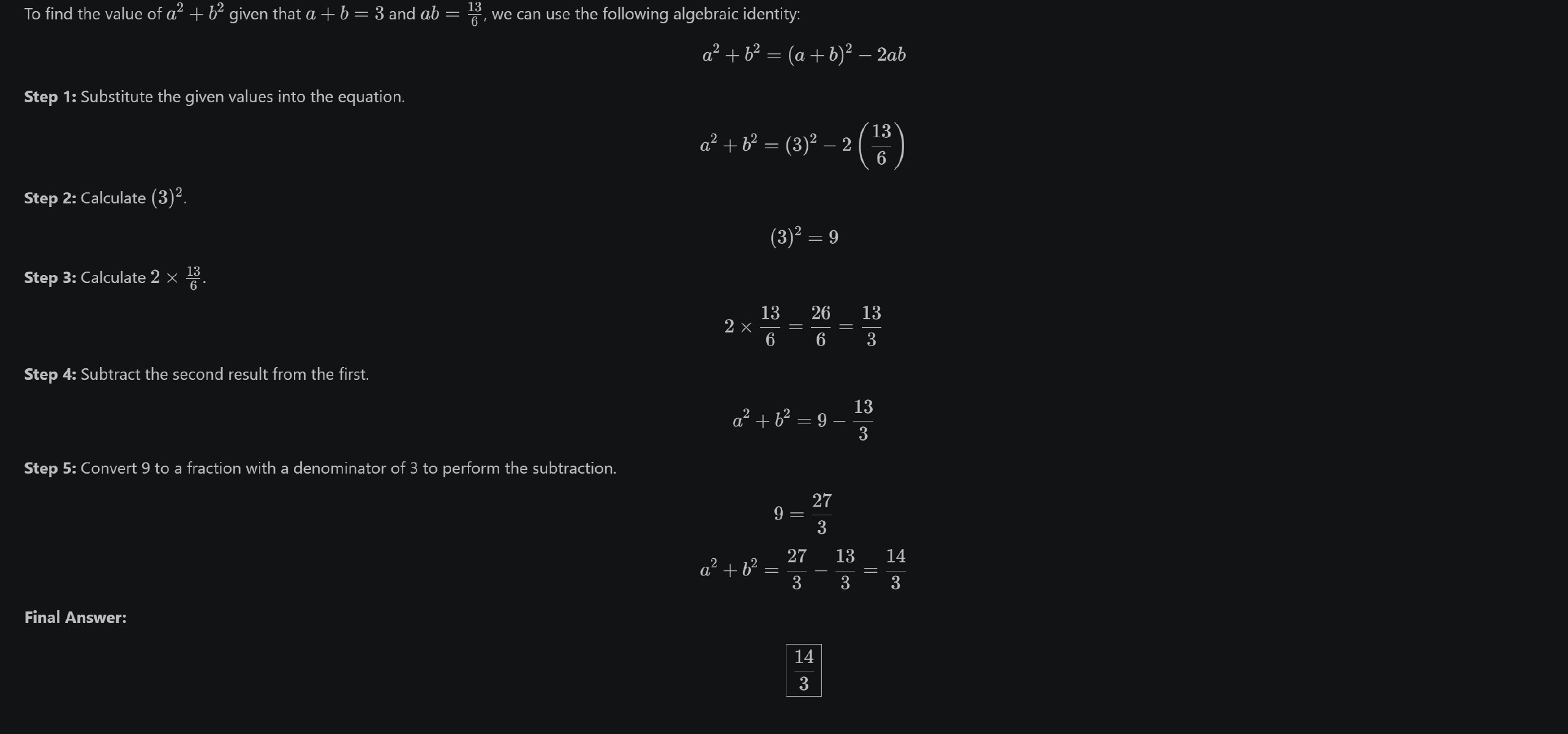
渲染一下:
import re
from IPython.display import Markdown, display


def format_latex_for_vscode(text: str) -> str:
    # 1. 把整行公式 \[ ... \] 转换为 $$ ... $$
    text = re.sub(r"\\\[", "$$", text)
    text = re.sub(r"\\\]", "$$", text)
    # 2. 把行内公式 \( ... \) 转换为 $ ... $
    text = re.sub(r"\\\((.*?)\\\)", r"$\1$", text)
    return text


# 转换后再渲染
display(Markdown(format_latex_for_vscode(all_tokens)))
2.3 封装 text generation
def generate_text_stream_concat(
    model, tokenizer, prompt, device, max_new_tokens,
    verbose=False,
):
    input_ids = torch.tensor( #A
        tokenizer.encode(prompt), device=device
        ).unsqueeze(0)

    generated_ids = []
    for token in generate_text_basic_stream_cache( #B
        model=model,
        token_ids=input_ids,
        max_new_tokens=max_new_tokens,
        eos_token_id=tokenizer.eos_token_id,
    ):
        next_token_id = token.squeeze(0)
        generated_ids.append(next_token_id.item())

        if verbose: #C
            print(
            tokenizer.decode(next_token_id.tolist()),
            end="",
            flush=True
        )
    return tokenizer.decode(generated_ids) #D
generated_text = generate_text_stream_concat(
    model, tokenizer, prompt, device,
    max_new_tokens=2048,
    verbose=True    #A
)
会跟前面输出一样。
2.4 答案提取
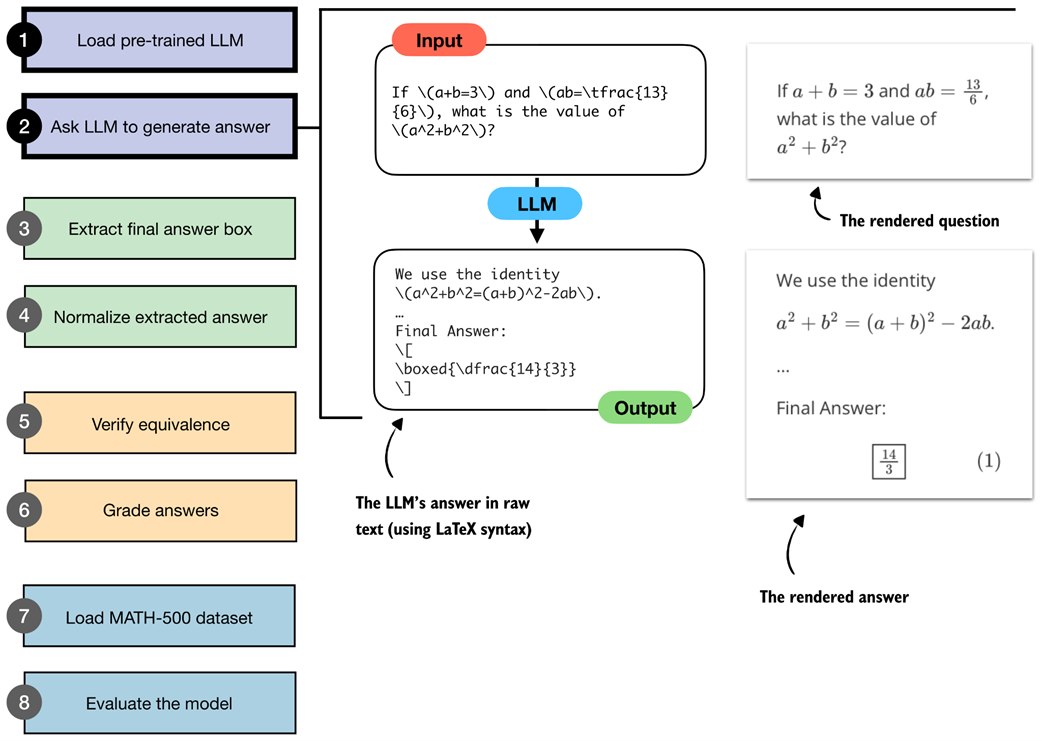
需要写个 api 提取答案,方便后续测评。
def get_last_boxed(text):
    boxed_start_idx = text.rfind(r"\boxed") #A
    if boxed_start_idx == -1:
        return None

    current_idx = boxed_start_idx + len(r"\boxed")  # B

    #C
    while current_idx < len(text) and text[current_idx].isspace():
        current_idx += 1

    #D
    if current_idx >= len(text) or text[current_idx] != "{":
        return None

    current_idx += 1
    brace_depth = 1
    content_start_idx = current_idx

    #E
    while current_idx < len(text) and brace_depth > 0:
        char = text[current_idx]
        if char == "{":
            brace_depth += 1
        elif char == "}":
            brace_depth -= 1
        current_idx += 1

    if brace_depth != 0:    # F
        return None

    return text[content_start_idx:current_idx - 1]
extracted_answer = get_last_boxed(model_answer)
print(extracted_answer)
\dfrac{14}{3}
也可以选择渲染一下:
from IPython.display import Math
display(Math(r"\dfrac{14}{3}"))
不过我们可以借助正则表达式来做答案提取:
import re

RE_NUMBER = re.compile( #A
    r"-?(?:\d+/\d+|\d+(?:\.\d+)?(?:[eE][+-]?\d+)?)"
)

def extract_final_candidate(text, fallback="number_then_full"):

    result = ""        #B

    if text: #C
        boxed = get_last_boxed(text.strip())
        if boxed:
            result = boxed.strip().strip("$ ")

        #D
        elif fallback in ("number_then_full", "number_only"):
            m = RE_NUMBER.findall(text)
            if m:
                result = m[-1] #E
            elif fallback == "number_then_full":

                result = text               #F
    return result

#A 用于从文本中抽取数值的正则表达式
#B 什么都没匹配到时的默认返回值
#C 如果存在 boxed 表达式,优先用它
#D 没有 boxed 表达式时,尝试回退策略
#E 使用最后一个数字
#F 连数字都没有时,返回整段文本
Q:为什么不让 LLM 来做提取
A:
因为任务机械、重复且简单(
2.5 标准化答案
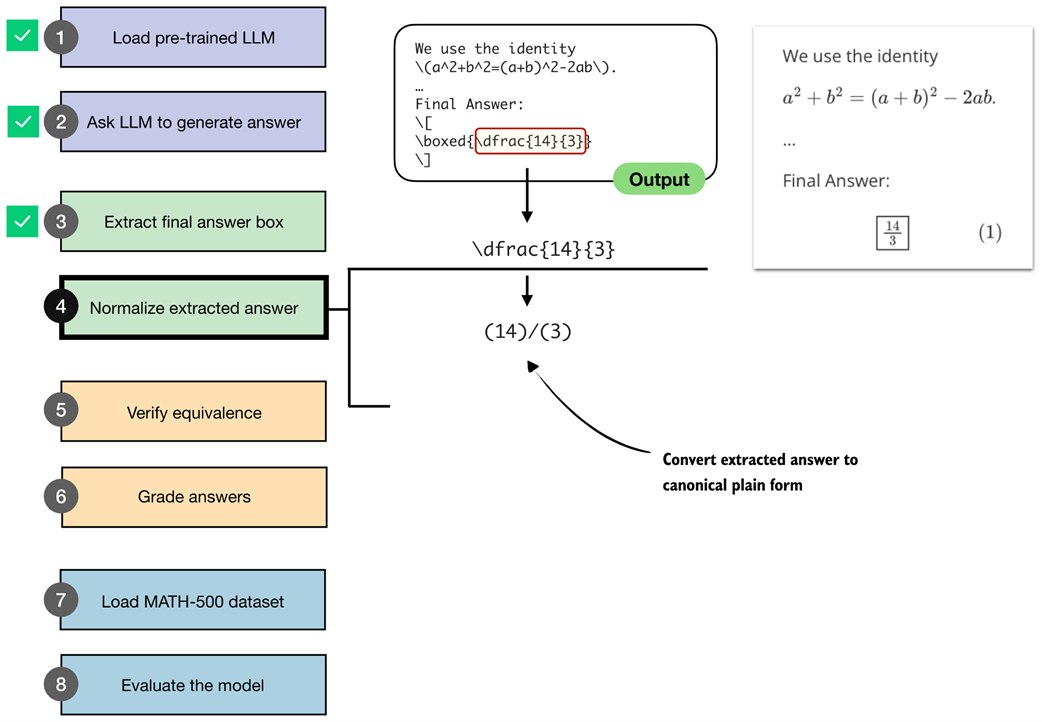
因为抽取出来的格式太多了:"\frac{14}{3}"、"14/3"、"$14/3$"、"(14)/(3)"。要实现一套稳健的检查系统,首先得有一种一致的比较方法。
我们可以写一些函数来处理成指定格式:
LATEX_FIXES = [ #A
    (r"\\left\s*", ""),
    (r"\\right\s*", ""),
    (r"\\,|\\!|\\;|\\:", ""),
    (r"\\cdot", "*"),
    (r"\u00B7|\u00D7", "*"),
    (r"\\\^\\circ", ""),
    (r"\\dfrac", r"\\frac"),
    (r"\\tfrac", r"\\frac"),
    (r"°", ""),
]

RE_SPECIAL = re.compile(r"<\|[^>]+?\|>") #B
SUPERSCRIPT_MAP = {
    "⁰": "0", "¹": "1", "²": "2", "³": "3", "⁴": "4",                 #C
    "⁵": "5", "⁶": "6", "⁷": "7", "⁸": "8", "⁹": "9",                   #C
    "⁺": "+", "⁻": "-", "⁽": "(", "⁾": ")",                             #C
}

def normalize_text(text):
    if not text:
        return ""
    text = RE_SPECIAL.sub("", text).strip()

    #D
    match = re.match(r"^[A-Za-z]\s*[.:]\s*(.+)$", text)
    if match:
        text = match.group(1)

    text = re.sub(r"\^\s*\{\s*\\circ\s*\}", "", text) #D
    text = re.sub(r"\^\s*\\circ", "", text)           #E
    text = text.replace("°", "")                      #E

    match = re.match(r"^\\text\{(?P<x>.+?)\}$", text) #F
    if match:
        text = match.group("x")

    text = re.sub(r"\\\(|\\\)|\\\[|\\\]", "", text)               #G

    for pat, rep in LATEX_FIXES:           #H
        text = re.sub(pat, rep, text)

    def convert_superscripts(s, base=None):
        converted = "".join(
            SUPERSCRIPT_MAP[ch] if ch in SUPERSCRIPT_MAP else ch
            for ch in s
        )
        if base is None:
            return converted
        return f"{base}**{converted}"

    text = re.sub(
        r"([0-9A-Za-z\)\]\}])([⁰¹²³⁴⁵⁶⁷⁸⁹⁺⁻]+)",
        lambda m: convert_superscripts(m.group(2), base=m.group(1)),
        text,
    )
    text = convert_superscripts(text)

    #I
    text = text.replace("\\%", "%").replace("$", "").replace("%", "")
    text = re.sub(
        r"\\sqrt\s*\{([^}]*)\}",
        lambda match: f"sqrt({match.group(1)})",
        text,
    )
    text = re.sub(
        r"\\sqrt\s+([^\\\s{}]+)",
        lambda match: f"sqrt({match.group(1)})",
        text,
    )

    #J
    text = re.sub(
        r"\\frac\s*\{([^{}]+)\}\s*\{([^{}]+)\}",
        lambda match: f"({match.group(1)})/({match.group(2)})",
        text,
    )
    text = re.sub(
        r"\\frac\s+([^\s{}]+)\s+([^\s{}]+)",
        lambda match: f"({match.group(1)})/({match.group(2)})",
        text,
    )

    #K
    text = text.replace("^", "**")
    text = re.sub(
        r"(?<=\d)\s+(\d+/\d+)",
        lambda match: "+" + match.group(1),
        text,
    )

    #L
    text = re.sub(
        r"(?<=\d),(?=\d\d\d(\D|$))",
        "",
        text,
    )

    return text.replace("{", "").replace("}", "").strip().lower()

#A 需要替换的 LaTeX 写法(左:原始写法,右:替换成什么)
#B 剥掉 <|assistant|> 这类聊天特殊 token
#C 把 Unicode 上标转换成普通文本幂次的字典
#D 去掉选择题的前导标号(例如 "c. 3" -> 3)
#E 去掉角度度数标记
#F 如果整串被 "\text{...}" 包着,就把它解开
#G 去掉行内/行间数学包裹符号:\( \) \[ \]
#H LaTeX 规范化
#I 规范数字与根号表达式
#J 把 LaTeX 分数改写成除法形式
#K 处理幂次和带分数
#L 去掉数字里的千位分隔符
print(normalize_text(extract_final_candidate(model_answer)))
(14)/(3)
print(normalize_text(r"\text{\[\frac{14}{3}\]}"))
(14)/(3)
2.6 答案验证
显然需要把抽取的答案与 ground truth 做比对,我们用一个符号数学引擎来解析抽取并归一化后的答案。这里选用 SymPy 这个开源数学库(https://sympy.org )。
SymPy 已经有二十年历史了,是 Python 科学计算的标准配置之一。
from sympy.parsing import sympy_parser as spp
from sympy.core.sympify import SympifyError
from sympy.polys.polyerrors import PolynomialError
from tokenize import TokenError

def sympy_parser(expr):
    if expr is None or len(expr) > 2000: #A
        return None

    try:
        return spp.parse_expr(
            expr,
            transformations=(
                *spp.standard_transformations, #B
                #C
                spp.implicit_multiplication_application,
            ),

            evaluate=True, #D
        )
    except (SympifyError, SyntaxError, TypeError, AttributeError,
            IndexError, TokenError, ValueError, PolynomialError):
        return None

#A 避免在超长的垃圾回复上崩溃
#B 标准变换,例如处理括号
#C 允许省略乘号(例如 2y -> 2*y)
#D 解析时即求值,简单常数会被化简(例如 2+3 -> 5)
sympy_parser里考虑的错误类型看起来多得有点夸张,但这些都是在全部 500 道 MATH-500 题目上评估模型时真实遇到过的错误,因为模型并不总能生成格式完美的输出。
看一下效果:
print(sympy_parser(normalize_text(
    extract_final_candidate(model_answer)
)))
14/3
print(sympy_parser("28/6"))
14/3
然后写一个等价检查函数:
from sympy import simplify

def equality_check(expr_gtruth, expr_pred):
    if expr_gtruth == expr_pred: #A
        return True

    #B
    gtruth, pred = sympy_parser(expr_gtruth), sympy_parser(expr_pred)

    if gtruth is not None and pred is not None: #C
        try:
            return simplify(gtruth - pred) == 0 #D
        except (SympifyError, TypeError):
            pass

    return False

#A 先检查两个表达式是不是完全相同的字符串
#B 把两个表达式都解析成 SymPy 对象(解析失败则返回 None)
#C 若两边都解析成功,尝试符号比较
#D 差值为 0 则等价
测一下:
print(equality_check(
    normalize_text("13/4."),
    normalize_text(r"(13)/(4)")
))
True
print(equality_check(
    normalize_text("0.5"),
    normalize_text(r"(1)/(2)")
))
True
print(equality_check(
    normalize_text("14/3"),
    normalize_text("15/3")
))
False
但是如果是多个结果,比如元组这种,就不太行:
print(equality_check(
    normalize_text("(14/3, 2/3)"),
    normalize_text("(14/3, 4/6)")
))
False
2.7 Grading answers
写一个拆分元组的函数:
def split_into_parts(text):
    result = [text]

    if text:         #A
        if (
                len(text) >= 2
                and text[0] in "([" and text[-1] in ")]"
                and "," in text[1:-1]
        ):
            items = [p.strip() for p in text[1:-1].split(",")] #B
            if all(items):
                result = items
    else: #C
        result = []

    return result

#A 检查 text 是否形如元组或列表,例如 "(a, b)" 或 "[a, b]"
#B 按括号内的逗号切分,并去掉空白
#C 如果 text 为空,返回空列表
split_into_parts(normalize_text(r"(14/3, 2/3)"))
['14/3', '2/3']
然后写一个比对预测答案和标准答案的函数:
def grade_answer(pred_text, gt_text):
    result = False   #A
    if pred_text is not None and gt_text is not None: #B
        gt_parts = split_into_parts(
            normalize_text(gt_text)
        )
        pred_parts = split_into_parts(
            normalize_text(pred_text)
        )

        if (gt_parts and pred_parts                #C
           and len(gt_parts) == len(pred_parts)): #C
            result = all(
                equality_check(gt, pred)
                for gt, pred in zip(gt_parts, pred_parts)
            ) #D

    return result         #E

#A 检查失败时的默认结果
#B 只有当两个输入都非空时才继续
#C 确保两边的有效子部分数量相同
#D 对每个子部分做数学等价性检查
#E 只有全部通过才返回 True
grade_answer("14/3", r"\frac{14}{3}")
True
grade_answer(r"(14/3, 2/3)", "(14/3, 4/6)")
True
跑几个样例:
tests = [ #A
        ("check_1", "3/4", r"\frac{3}{4}", True),
        ("check_2", "(3)/(4)", r"3/4", True),
        ("check_3", r"\frac{\sqrt{8}}{2}", "sqrt(2)", True),
        ("check_4", r"\( \frac{1}{2} + \frac{1}{6} \)", "2/3", True),
        ("check_5", "(1, 2)", r"(1,2)", True),
        ("check_6", "(2, 1)", "(1, 2)", False),
        ("check_7", "(1, 2, 3)", "(1, 2)", False),
        ("check_8", "0.5", "1/2", True),
        ("check_9", "0.3333333333", "1/3", False),
        ("check_10", "1,234/2", "617", True),
        ("check_11", r"\text{2/3}", "2/3", True),
        ("check_12", "50%", "1/2", False),
        ("check_13", r"2\cdot 3/4", "3/2", True),
        ("check_14", r"90^\circ", "90", True),
        ("check_15", r"\left(\frac{3}{4}\right)", "3/4", True),
        ("check_16", r"2²", "2**2", True),
    ]

def run_demos_table(tests):
    header = ("Test", "Expect", "Got", "Status")
    rows = []
    for name, pred, gtruth, expect in tests:
        got = grade_answer(pred, gtruth) #B
        status = "PASS" if got == expect else "FAIL"
        rows.append((name, str(expect), str(got), status))

    data = [header] + rows

    col_widths = [ #C
        max(len(row[i]) for row in data)
        for i in range(len(header))
    ]

    for row in data: #D
        line = " | ".join(
            row[i].ljust(col_widths[i])
            for i in range(len(header))
        )
        print(line)

    passed = sum(r[3] == "PASS" for r in rows) #E
    print(f"\nPassed {passed}/{len(rows)}")    #E

#A 定义测试用例:(名称, 预测, 标准答案, 期望结果)
#B 运行等价性检查
#C 计算每列最大宽度以对齐表格
#D 逐行打印表格
#E 打印通过情况的汇总
run_demos_table(tests)
Test     | Expect | Got   | Status
check_1  | True   | True  | PASS
check_2  | True   | True  | PASS
check_3  | True   | True  | PASS
check_4  | True   | True  | PASS
check_5  | True   | True  | PASS
check_6  | False  | False | PASS
check_7  | False  | False | PASS
check_8  | True   | True  | PASS
check_9  | False  | False | PASS
check_10 | True   | True  | PASS
check_11 | True   | True  | PASS
check_12 | False  | False | PASS
check_13 | True   | True  | PASS
check_14 | True   | True  | PASS
check_15 | True   | True  | PASS
check_16 | True   | True  | PASS

Passed 16/16
2.8 加载 dataset
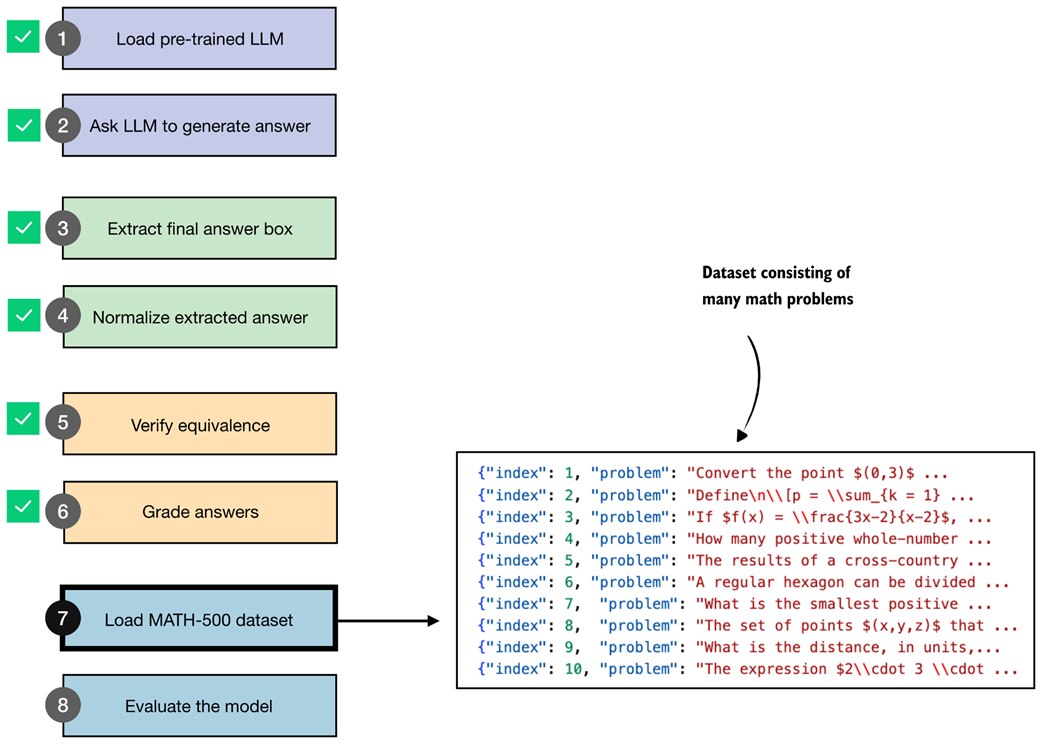
因为对于这种数学问题,往往需要很久的推理,所以选了 MATH-500 这个dataset。
加载一下:
import json
import requests

def load_math500_test(local_path="math500_test.json", save_copy=True):
    local_path = Path(local_path)
    url = (
        "https://raw.githubusercontent.com/rasbt/reasoning-from-scratch/"
        "main/ch03/01_main-chapter-code/math500_test.json"
    )

    if local_path.exists():
        with local_path.open("r", encoding="utf-8") as f:
            data = json.load(f)
    else:
        r = requests.get(url, timeout=30)
        r.raise_for_status()
        data = r.json()

        if save_copy: # 保存一份本地副本
            with local_path.open("w", encoding="utf-8") as f:
                json.dump(data, f, indent=2)

    return data

math_data = load_math500_test()
print("Number of entries:", len(math_data))
Number of entries: 500
可以看一个:
from pprint import pprint
pprint(math_data[0])
{'answer': '\\left( 3, \\frac{\\pi}{2} \\right)',
 'level': 2,
 'problem': 'Convert the point $(0,3)$ in rectangular coordinates to polar '
            'coordinates.  Enter your answer in the form $(r,\\theta),$ where '
            '$r > 0$ and $0 \\le \\theta < 2 \\pi.$',
 'solution': 'We have that $r = \\sqrt{0^2 + 3^2} = 3.$  Also, if we draw the '
             'line connecting the origin and $(0,3),$ this line makes an angle '
             'of $\\frac{\\pi}{2}$ with the positive $x$-axis.\n'
             '\n'
             '[asy]\n'
             'unitsize(0.8 cm);\n'
             '\n'
             'draw((-0.5,0)--(3.5,0));\n'
             'draw((0,-0.5)--(0,3.5));\n'
             'draw(arc((0,0),3,0,90),red,Arrow(6));\n'
             '\n'
             'dot((0,3), red);\n'
             'label("$(0,3)$", (0,3), W);\n'
             'dot((3,0), red);\n'
             '[/asy]\n'
             '\n'
             'Therefore, the polar coordinates are $\\boxed{\\left( 3, '
             '\\frac{\\pi}{2} \\right)}.$',
 'subject': 'Precalculus',
 'unique_id': 'test/precalculus/807.json'}
2.9 模型评估
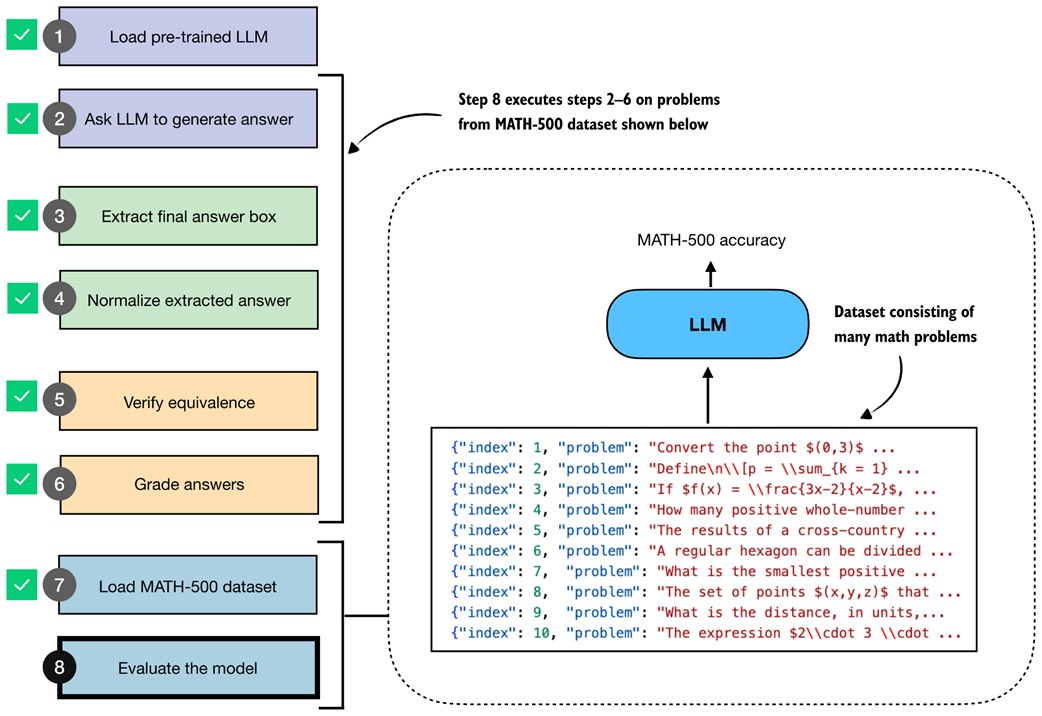
评估prompt:
def render_prompt(prompt):
    template = (
        "You are a helpful math assistant.\n"
        "Answer the question and write the final result on a new line as:\n"
        "\\boxed{ANSWER}\n\n"
        f"Question:\n{prompt}\n\nAnswer:"
    )
    return template
试个例题:
prompt = (
    r"If $a+b=3$ and $ab=\tfrac{13}{6}$, "
    r"what is the value of $a^2+b^2$?"
)
prompt_fmt = render_prompt(prompt)
print(prompt_fmt)
You are a helpful math assistant.
Answer the question and write the final result on a new line as:
\boxed{ANSWER}

Question:
If $a+b=3$ and $ab=\tfrac{13}{6}$, what is the value of $a^2+b^2$?

Answer:
然后扔给LLM:
generated_text = generate_text_stream_concat(
    model, tokenizer, prompt_fmt, device,
    max_new_tokens=2048,
    verbose=True
)
\boxed{10}
然后就答错了,base model 比较菜,当然也跟 prompt 有关,加一些CoT引导,说不定就对了。
写一个eval的demo:
def mini_eval_demo(model, tokenizer, device):
    ex = { #A
        "problem": "Compute 1/2 + 1/6.",
        "answer": "2/3"
    }
    prompt = render_prompt(ex["problem"])     #B 1. 应用提示模板
    gen_text = generate_text_stream_concat( #C 2. 生成回复
        model, tokenizer, prompt, device,     #C
        max_new_tokens=64,                    #C
    )                                         #C
    pred_answer = extract_final_candidate(gen_text) #D 3. 抽取并归一化答案
    is_correct = grade_answer(                      #E 4. 打分
        pred_answer, ex["answer"]                   #E
    )                                               #E

    print(f"Device: {device}")
    print(f"Prediction: {pred_answer}")
    print(f"Ground truth: {ex['answer']}")
    print(f"Correct: {is_correct}")

#A 带 "problem" 和 "answer" 字段的测试样例
#B 1. 应用提示模板
#C 2. 生成回复
#D 3. 抽取并归一化答案
#E 4. 打分
mini_eval_demo(model, tokenizer, device)
Device: cuda
Prediction: 1/3
Ground truth: 2/3
Correct: False
然后写一下端到端测评:
import time

def eta_progress_message( #A
    processed,
    total,
    start_time,
    show_eta=False,
    label="Progress",
):
    progress = f"{label}: {processed}/{total}"
    pad_width = len(f"{label}: {total}/{total} | ETA: 00h 00m 00s")
    if not show_eta or processed <= 0:
        return progress.ljust(pad_width)

    elapsed = time.time() - start_time
    if elapsed <= 0:
        return progress.ljust(pad_width)

    remaining = max(total - processed, 0)

    if processed:
        avg_time = elapsed / processed
        eta_seconds = avg_time * remaining
    else:
        eta_seconds = 0

    eta_seconds = max(int(round(eta_seconds)), 0)
    minutes, rem_seconds = divmod(eta_seconds, 60)
    hours, minutes = divmod(minutes, 60)
    if hours:
        eta = f"{hours}h {minutes:02d}m {rem_seconds:02d}s"
    elif minutes:
        eta = f"{minutes:02d}m {rem_seconds:02d}s"
    else:
        eta = f"{rem_seconds:02d}s"

    message = f"{progress} | ETA: {eta}"
    return message.ljust(pad_width)

def evaluate_math500_stream(
    model,
    tokenizer,
    device,
    math_data,
    out_path=None,
    max_new_tokens=512,
    verbose=False,
):

    if out_path is None:
        dev_name = str(device).replace(":", "-")     #B
        out_path = Path(f"math500-{dev_name}.jsonl")

    num_examples = len(math_data)
    num_correct = 0
    start_time = time.time()

    with open(out_path, "w", encoding="utf-8") as f:            #C
        for i, row in enumerate(math_data, start=1):
            prompt = render_prompt(row["problem"])              #D 1. 应用提示模板
            gen_text = generate_text_stream_concat(             #E 2. 生成回复
                model, tokenizer, prompt, device,
                max_new_tokens=max_new_tokens,
                verbose=verbose,
            )

            extracted = extract_final_candidate(                #F 3. 抽取并归一化答案
                gen_text
            )
            is_correct = grade_answer(                          #G 4. 打分
                extracted, row["answer"]
            )
            num_correct += int(is_correct)

            record = {                                 #H
                "index": i,
                "problem": row["problem"],
                "gtruth_answer": row["answer"],
                "generated_text": gen_text,
                "extracted": extracted,
                "correct": bool(is_correct),
            }
            f.write(json.dumps(record, ensure_ascii=False) + "\n")

            progress_msg = eta_progress_message(
                processed=i,
                total=num_examples,
                start_time=start_time,
                show_eta=True,
                label="MATH-500",
            )
            print(progress_msg, end="\r", flush=True)

            if verbose:                                #I
                print(
                    f"\n\n{'='*50}\n{progress_msg}\n"
                    f"{'='*50}\nExtracted: {extracted}\n"
                    f"Expected: {row['answer']}\n"
                    f"Correct so far: {num_correct}\n{'-'*50}"
                )

    seconds_elapsed = time.time() - start_time
    acc = num_correct / num_examples if num_examples else 0.0
    print(f"\nAccuracy: {acc*100:.1f}% ({num_correct}/{num_examples})")
    print(f"Total time: {seconds_elapsed/60:.1f} min")
    print(f"Logs written to: {out_path}")
    return num_correct, num_examples, acc

#A 打印进度、可选附带 ETA(预计剩余时间)的辅助函数
#B 让文件名在 Windows 上也兼容
#C 保存结果以便查看
#D 1. 应用提示模板
#E 2. 生成回复
#F 3. 抽取并归一化答案
#G 4. 打分
#H 需要保存下来供查看的记录
#I 生成过程中打印回复
然后拿base model跑一下:
print("Model:", WHICH_MODEL)
num_correct, num_examples, acc = evaluate_math500_stream(
    model, tokenizer, device,
    math_data=math_data[:10], #A
    max_new_tokens=2048,
    verbose=False              #B
)
#A 只在头 10 个样例上评估
#B 设为 True 可以在生成时实时看回复
Model: base
MATH-500: 10/10 | ETA: 00s
Accuracy: 30.0% (3/10)
Total time: 0.4 min
Logs written to: math500-cuda.jsonl
base model 还是太菜了。
写一个脚本,方便测各个model:
import argparse
import json
import time
from pathlib import Path

import torch

from reasoning_from_scratch.qwen3_batched import (
    Qwen3Model,
    QWEN_CONFIG_06_B
)
from reasoning_from_scratch.ch02 import get_device
from reasoning_from_scratch.ch03 import (
    load_math500_test,
    render_prompt,
    extract_final_candidate,
    grade_answer,
    eta_progress_message,
    load_tokenizer_only
)
from reasoning_from_scratch.qwen3_batched import (
    load_model_and_tokenizer,
)


def evaluate_math500_batched(
    model,
    tokenizer,
    device,
    math_data,
    out_path=None,
    max_new_tokens=512,
    verbose=False,
    batch_size=4,
    show_eta=False,
):
    model.eval()

    # Default output path like the streaming variant
    if out_path is None:
        dev_name = str(device).replace(":", "-")  # Make filename compatible with Windows
        out_path = Path(f"math500-{dev_name}.jsonl")

    num_examples = len(math_data)
    num_correct = 0

    start_time = time.time()

    eos_id = getattr(tokenizer, "eos_token_id", None)
    pad_id = getattr(tokenizer, "pad_token_id", None)

    with open(out_path, "w", encoding="utf-8") as f:
        # Batched loop
        for start in range(0, num_examples, batch_size):
            batch = math_data[start:start + batch_size]

            prompts = [render_prompt(row["problem"]) for row in batch]

            # Encode and left-pad
            tokenized = [tokenizer.encode(p) for p in prompts]
            max_len = max(len(t) for t in tokenized)
            left_padded = [
                ([pad_id] * (max_len - len(t)) + t) if pad_id is not None else t
                for t in tokenized
            ]
            input_ids = torch.tensor(left_padded, device=device, dtype=torch.long)

            # Generate (batched)
            gen = generate_text_basic_batched_cache(
                model,
                token_ids=input_ids,
                max_new_tokens=max_new_tokens,
                eos_token_id=eos_id,
                pad_id=pad_id,
            )  # shape: (B, T_new)

            # Process each row
            B = gen.size(0)
            for b_idx in range(B):
                # Match the variable names used by evaluate_math500_stream
                i = start + b_idx + 1
                row = batch[b_idx]

                row_tokens = gen[b_idx]
                # Cut at first EOS if present
                if eos_id is not None:
                    eos_pos = (row_tokens == eos_id).nonzero(as_tuple=True)[0]
                    if len(eos_pos) > 0:
                        row_tokens = row_tokens[: eos_pos[0]]

                gen_text = tokenizer.decode(row_tokens.tolist())
                extracted = extract_final_candidate(gen_text)
                is_correct = grade_answer(extracted, row["answer"])
                num_correct += int(is_correct)

                record = {  # Record to be saved for inspection
                    "index": i,
                    "problem": row["problem"],
                    "gtruth_answer": row["answer"],
                    "generated_text": gen_text,
                    "extracted": extracted,
                    "correct": bool(is_correct),
                }
                f.write(json.dumps(record, ensure_ascii=False) + "\n")

                progress_msg = eta_progress_message(
                    processed=i,
                    total=num_examples,
                    start_time=start_time,
                    show_eta=show_eta,
                    label="MATH-500",
                )
                print(progress_msg, end="\r", flush=True)
                if verbose:  # Print responses during the generation process
                    print(
                        f"\n\n{'='*50}\n{progress_msg}\n"
                        f"{'='*50}\nExtracted: {extracted}\n"
                        f"Expected:  {row['answer']}\n"
                        f"Correct so far: {num_correct}\n{'-'*50}"
                    )

    # Print summary information
    seconds_elapsed = time.time() - start_time
    acc = num_correct / num_examples if num_examples else 0.0
    print(f"\nAccuracy: {acc*100:.1f}% ({num_correct}/{num_examples})")
    print(f"Total time: {seconds_elapsed/60:.1f} min")
    print(f"Logs written to: {out_path}")
    return num_correct, num_examples, acc


def parse_args():
    parser = argparse.ArgumentParser(formatter_class=argparse.ArgumentDefaultsHelpFormatter)
    parser.add_argument(
        "--device",
        type=str,
        default="auto",
        help="Device to use: 'auto', or any torch device string like 'cpu', 'cuda', 'cuda:0', 'mps'.",
    )
    parser.add_argument(
        "--which_model",
        type=str,
        default="base",
        choices=["base", "reasoning", "instruct"],
        help="Model variant to load",
    )
    parser.add_argument(
        "--dataset_size",
        type=int,
        default=10,
        help="Number of MATH-500 examples to evaluate",
    )
    parser.add_argument(
        "--max_new_tokens",
        type=int,
        default=2048,
        help="Max new tokens for generation",
    )
    parser.add_argument(
        "--compile",
        action="store_true",
        help="Enable torch.compile for the model.",
    )
    parser.add_argument(
        "--checkpoint_path",
        type=str,
        default=None,
        help="Optional path to a .pth checkpoint to load model weights from.",
    )
    parser.add_argument(
        "--batch_size",
        type=int,
        default=4,
        help="Batch size for batched generation",
    )
    parser.add_argument(
        "--verbose",
        action="store_true",
        help="Print per-sample correctness while evaluating.",
    )
    parser.add_argument(
        "--disable_efficient_mode",
        action="store_true",
        help="Uses an alternative implementation of batched inference that is simpler but more memory and compute intense.",
    )
    return parser.parse_args()


if __name__ == "__main__":
    args = parse_args()

    if args.disable_efficient_mode:
        from reasoning_from_scratch.qwen3_batched import (
            generate_text_basic_batched_cache,
        )
    else:
        from reasoning_from_scratch.qwen3_batched import (
            generate_text_basic_batched_cache_stop as generate_text_basic_batched_cache,
        )
    if args.device == "auto":
        device = get_device()
    else:
        device = torch.device(args.device)

    which_model = args.which_model
    dataset_size = args.dataset_size
    max_new_tokens = args.max_new_tokens
    batch_size = args.batch_size

    print("Model:", which_model)
    print("Device:", device)
    dev_name = str(device).replace(":", "-")
    print("Batch size:", batch_size)

    math_data = load_math500_test()[:dataset_size]
    if args.which_model == "instruct":
        which_model = "reasoning"
    else:
        which_model = args.which_model

    if args.checkpoint_path:
        # To load the saved RL checkpoint files from chapter 6
        tokenizer = load_tokenizer_only(which_model=which_model)
        model = Qwen3Model(QWEN_CONFIG_06_B)
        model.to(device)
        state_dict = torch.load(args.checkpoint_path, map_location=device)
        model.load_state_dict(state_dict)
        if args.compile:
            torch._dynamo.config.allow_unspec_int_on_nn_module = True
            model = torch.compile(model)
    else:
        model, tokenizer = load_model_and_tokenizer(
            which_model=which_model,
            device=device,
            use_compile=args.compile
        )
    if args.which_model == "instruct":
        tokenizer.add_thinking = False

    out_path = f"math500_{which_model}-{dev_name}-batched-bs{batch_size}.jsonl"
    num_correct, num_examples, acc = evaluate_math500_batched(
        model=model,
        tokenizer=tokenizer,
        device=device,
        math_data=math_data,
        batch_size=batch_size,
        max_new_tokens=max_new_tokens,
        out_path=out_path,
        verbose=args.verbose,
        show_eta=True,
    )
然后拿 reasoning model 在单张 4090 24GB 上跑一下子集测试:
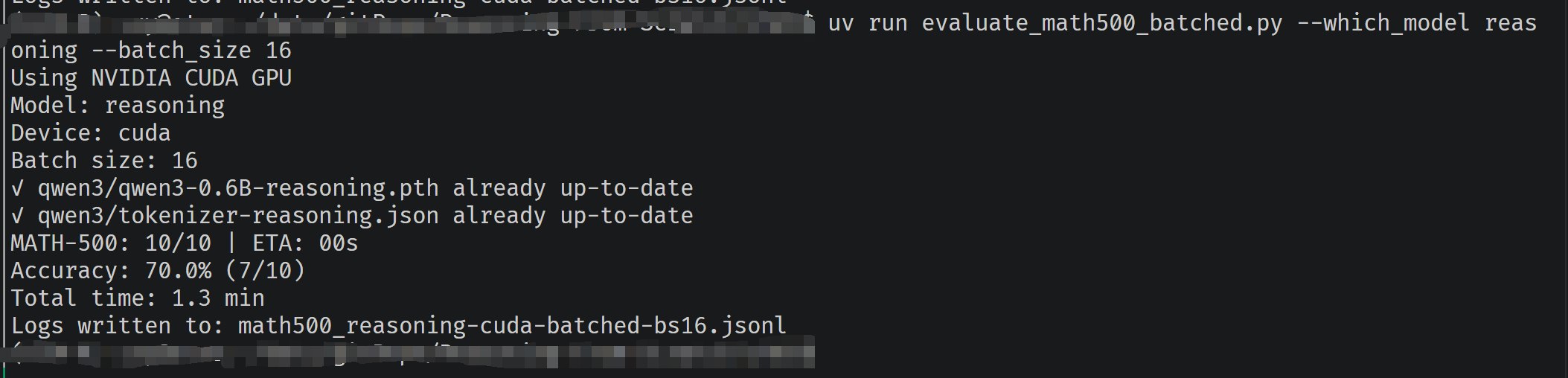
全量测试:

其实效果也一般(
不过对于 0.6B 的模型而且simple prompt 来说貌似也可以了?

说些什么吧!